
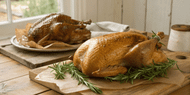
Christmas Turkey vs Goose
Posted by Copas Farm Shop on 2nd Nov 2026
For most festive tables, a well-reared turkey is the stronger choice: it feeds a crowd efficiently, suits the classic British Christmas spread, and costs less per kilogram than goose. Goose offers richer, darker meat with a distinctive depth of flavour, a genuine treat, but one that serves fewer people and carries a higher price.
Key takeaways
- A free-range turkey provides roughly 500g of oven-ready weight per person; goose yields less meat relative to its frame, so allow 600 to 800g per person for a goose.
- Free-range goose costs significantly more per kilogram than turkey and produces less usable meat, making it the more expensive choice per head even before accounting for side dishes.
- Goose meat is darker, richer and more intensely flavoured throughout, there is no real white-meat equivalent; turkey offers both white breast and darker leg meat, suiting a wider range of tastes at the table.
- The fat rendered from a roasting goose is a by-product worth keeping: strained into a jar, it produces exceptional roast potatoes and keeps in the fridge for up to three months.
- Both birds reward slow-growing and free-range rearing. A factory bird, turkey or goose, delivers a fraction of the flavour of a one of which as been reared on open-pastures.
How do turkey and goose actually taste?
Turkey and goose are different eating experiences, not simply interchangeable centrepieces. A slow-grown, free-range turkey, dry-aged before delivery, produces breast meat that is mild, tender and well-suited to the strong flavours of the classic Christmas spread: stuffing, pigs in blankets, rich gravy. The legs and thighs are darker and more savoury. The overall character is generous and crowd-pleasing.
Goose is more singular. Every part of the bird, breast included, is dark, richly flavoured and noticeably fattier. The fat bastes the meat throughout cooking, keeping it succulent, and the finished result has a depth closer to duck than to turkey. It's a more demanding flavour that most guests find either impressive or a touch overwhelming; it rarely divides a table quietly.
The provenance of the bird matters at least as much as the species. Importantly, a free-range, slow-grown turkey from a farm that takes rearing seriously will outperform a commercially reared goose on every measure of flavour. The comparison only becomes fair when both birds have been given time and space.
How do turkey and goose compare on cost?
Goose costs more per kilogram than turkey, and because goose carries less meat relative to its frame, the effective cost per head is substantially higher. A goose suitable for six to eight people will typically weigh around 5kg oven-ready; a turkey of similar oven-ready weight will comfortably feed ten to twelve. For a large gathering, the economics of turkey are considerably more straightforward.
| Turkey | Goose | |
|---|---|---|
| Typical serves | 10 to 12 from a 5 to 6kg bird | 6 to 8 from a 5kg bird |
| Meat character | White breast + dark leg | All dark, richly flavoured |
| Fat yield | Modest dripping | Abundant, 500ml+ per roast |
| Cost per head | Lower | Notably higher |
| Best for | Larger gatherings | Smaller, more intimate tables |
| Limitation | Less distinctive than goose | Serves fewer; strong flavour |
The goose's most famous by-product, the rendered fat, does offset part of the cost. A single roast yields enough fat for roast potatoes across several subsequent meals, which has a practical value that turkey dripping can't match.
Which bird suits your table?
The decision is primarily a question of numbers and preference, not prestige. If you're feeding more than eight people, turkey is the sensible choice: it scales, it carves well, and the mild flavour works for every guest.
Goose earns its place at a smaller, more deliberate gathering, six to eight people who appreciate rich, gamey flavour and are unlikely to include children who prefer milder meat. It is also worth considering if you already plan to serve a substantial ham or another centrepiece alongside it, keeping the goose as a second star rather than asking it to feed the whole table.
What about leftovers?
In our work with Copas Farm Shop's customers over many years, turkey's volume of leftover meat is one of its most consistently appreciated qualities. Cold turkey works in sandwiches, pies, soups and Coronation turkey burgers. Goose leftovers are equally good but fewer in volume: shredded cold goose through a warm salad with orange and watercress is the classic treatment, or a Boxing Day hash with the goose-fat potatoes.
Both birds reward careful storage: keep carved meat in the fridge within two hours of serving and use within three days.
Frequently Asked Questions
Is goose healthier than turkey at Christmas? Goose contains more fat than turkey, particularly in the skin and meat. Turkey breast, in particular, is one of the leaner proteins available. If fat content is a consideration, turkey is the lighter option, though the fat in a goose is largely unsaturated and has long been valued in traditional cooking.
Can you cook turkey and goose together for Christmas dinner? Yes, and it's a practical solution for larger gatherings with varied preferences. Roast the goose first, rest it, and use the rendered fat for your roast potatoes while the turkey finishes. Many households pair a smaller goose with a turkey crown for a table that covers both richness and volume.
Does a free-range goose taste better than a supermarket one? Considerably. A goose reared slowly with access to pasture develops the fat coverage and muscular depth that defines its flavour. A commercially produced goose will be paler in flavour and less impressive on the table. The same principle applies to turkey: rearing method is the single largest determinant of how the bird tastes.
How far in advance should you order a Christmas goose? Order as early as possible, October at the latest. Free-range geese are reared in limited numbers each season and tend to sell out well before December. Copas free-range geese are available on a first-come, first-served basis, and popular sizes go quickly.
What wine pairs best with roast goose versus turkey? Goose, with its richness, suits a fuller-bodied red, a Pinot Noir or a Côtes du Rhône, or a dry, aromatic white such as Alsace Riesling that can cut through the fat. Turkey is more versatile: a light Burgundy, a white Burgundy or even a good English sparkling wine all work well. You'll find considered options in the Christmas Cellar to match either bird.
Written by the Copas team, farming free-range turkeys, geese and seasonal meats in the UK since 1957. Last updated: 2 November 2026