
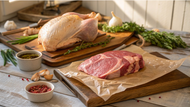
Free-range turkey vs. beef: which makes the better centrepiece for your table?
Posted by Copas Farm Shop on 21st Jul 2026
For most celebratory meals, free-range turkey is the more versatile, crowd-pleasing centrepiece — feeding larger groups at a lower cost per portion — while beef delivers a richer, more intense flavour for smaller, intimate gatherings. The right choice depends on your guest count, budget, and the kind of table you want to set.
Key takeaways
- A whole free-range turkey typically serves 8–14 people; a beef joint of comparable quality serves 4–8, making turkey the stronger choice for larger gatherings.
- Free-range turkey from a slow-grown farm costs roughly £8–£12 per kg; well-aged beef joints such as rib of beef or fillet run from £25–£50 per kg.
- Dry-aged, slow-grown turkey carries significantly more flavour than supermarket birds — depth of flavour comes from welfare and time on pasture, not breed alone.
- Beef requires less hands-on cook time but demands precise resting; turkey demands more active management but forgives a wider cooking window.
- At Copas, Free range turkeys are slow-grown on open pasture, hand-plucked, and dry-aged — the same standard the family applies to its own table.
What is the real difference between free-range turkey and beef as a centrepiece?
Free-range turkey and beef differ in flavour profile, serving yield, cost per portion, and the kind of occasion they suit best. Turkey is a lean, lightly flavoured white meat that absorbs seasoning and resting juices readily. Beef — particularly a standing rib or dry-aged sirloin — delivers a deep, iron-rich savouriness that needs very little adornment.
The centrepiece question is really a question of scale and tone. Turkey says abundance and sharing; beef says occasion and intensity.
How do free-range turkey and beef compare directly?
| Option | Best for | Approx. cost per kg | Honest limitation |
|---|---|---|---|
| Free-range turkey | 8–14 guests, Christmas, Thanksgiving | £8–£12 | Lean meat can dry out if overcooked |
| Rib of beef (dry-aged) | 4–8 guests, intimate celebration | £30–£45 | High cost; narrower serving window |
| Beef fillet | 4–6 guests, formal dinner | £40–£50 | Less forgiving; no bone for flavour |
| Beef brisket (slow-roast) | 6–10 guests, relaxed gathering | £10–£18 | Requires 6–8 hours cooking time |
Which is better value for a large gathering?
Turkey wins clearly on cost per portion for groups of eight or more. A 6 kg free-range turkey at £10 per kg costs £60 and feeds ten people comfortably — that's £6 per head. A comparable rib of beef joint feeding the same number would cost upwards of £180. The gap is substantial, and it widens the more guests you seat.
That said, value isn't only about price. A well-sourced Christmas Turkey from a farm that slow-grows its birds will outperform a cheap supermarket joint of beef on flavour, texture, and the satisfaction of carving at the table.
Does free-range turkey actually taste better than standard turkey?
Yes — meaningfully so. Birds raised on open pasture and grown slowly over a longer period develop denser muscle tissue and more fat marbling than fast-grown indoor birds. At Copas, turkeys are raised on Buckinghamshire pasture, hand-plucked, and dry-aged, which draws out moisture and concentrates flavour in ways a standard fresh bird can't match.
In our experience across decades of growing, the flavour difference between a slow-grown, dry-aged bird and a supermarket turkey is more pronounced than the difference between good and average beef.
Which is easier to cook well?
Beef is technically easier for a confident cook. A dry-aged rib of beef needs seasoning, high-heat searing, and careful resting — roughly 15 minutes per 500 g at 180°C, then 30 minutes resting under foil. The margin for error is small at the rare end, but the process itself is straightforward.
Turkey demands more attention. A whole bird must be cooked through completely — the breast can dry out before the legs are done unless you spatchcock, tent with foil, or baste regularly. The reward for getting it right is a table-filling roast that serves everyone generously.
Steps for roasting a free-range turkey well
- Remove the bird from the fridge 2 hours before cooking to bring it to room temperature.
- Rub butter or a flavoured fat under and over the skin.
- Roast at 190°C, allowing 40 minutes per kg plus 20 minutes.
- Tent loosely with foil after the first hour to protect the breast.
- Rest for a minimum of 45 minutes before carving — this is not optional.
What occasions suit turkey, and what occasions suit beef?
Turkey is the natural choice for Christmas, Thanksgiving, or any gathering where the table needs to feed a crowd and leftovers are part of the pleasure. Cold turkey the next day — in sandwiches, salads, or a hash — is part of the occasion.
Notably, beef suits a smaller, more formal celebration: a winter birthday dinner, an anniversary, or a Sunday roast elevated to something special. A dry-aged rib of beef on the bone is a statement piece, but it's a statement for six people, not sixteen.
Frequently Asked Questions
Is free-range turkey healthier than beef? Turkey breast is lower in saturated fat than most beef cuts, making it the leaner choice. However, quality matters more than species — slow-grown, pasture-raised animals of either kind produce meat with a better nutritional profile than fast-grown alternatives.
How much turkey do I need per person? Allow approximately 500 g of whole bird weight per person. A 5 kg turkey feeds around ten people with enough left over for the following day.
Can I order a free-range turkey online in the UK? Yes. Farms including Copas offer direct-to-door delivery of fresh, dry-aged free-range turkeys, typically with orders opening several months before Christmas. Early ordering is advised — birds sell out most years.
What cut of beef is best as a centrepiece? Rib of beef on the bone is the most dramatic and flavourful centrepiece cut. It holds its shape during roasting, the bone adds flavour, and it carves well at the table.
Is dry-aged turkey worth the extra cost? Yes. Dry-ageing removes surface moisture, concentrates the flavour of the meat, and improves texture. The difference is noticeable at the table, particularly when compared with a standard supermarket bird.
How far in advance should I order a Christmas turkey? Most premium farms recommend ordering by October, and some sell out before that. For slow-grown, free-range birds in particular, supply is fixed by how many birds were put to pasture months earlier — ordering early is the only reliable way to secure one.