
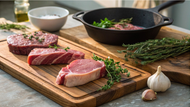
How to Cook Different Meats to Their Best
Posted by Copas Farm Shop on 9th Sep 2026
Cooking meat well comes down to matching the right method to the right cut. Beef benefits from high heat or slow braising depending on the cut; lamb suits roasting or grilling; pork needs thorough cooking; chicken and turkey demand careful temperature control; and game meats reward low, slow heat. Internal temperature is always the final arbiter.
Key takeaways
- Safe internal temperatures vary by meat: beef and lamb can be served from 60°C (medium-rare); pork and minced meats need 71°C; whole poultry requires 75°C at the thickest part of the thigh.
- Resting meat after cooking, roughly one minute per 100g, allows juices to redistribute, improving flavour and texture noticeably.
- Dry-aged beef and slow-grown poultry carry deeper flavour than commodity equivalents and respond better to simple seasoning and high-heat cooking.
- Game meats such as venison are naturally lean and overcook quickly; they benefit from brief, high-heat searing or slow braising, never long roasting at high temperatures.
- Turkey is the most commonly overcooked bird; removing it from the oven at 74°C internal and tenting with foil is the single most effective fix.
What does "cooking meat to its best" actually mean?
It means applying the method that suits the cut's structure, specifically its fat content, connective tissue, and muscle fibre density. A tough, collagen-rich cut like beef shin converts that collagen to gelatine only with long, moist heat above 80°C. A tender cut like a ribeye steak needs nothing more than two minutes each side in a very hot pan. Using the wrong method for the cut is the most common reason home-cooked meat disappoints.
How do you cook beef to get the most flavour?
Beef divides cleanly into quick-cook cuts and slow-cook cuts. Steaks, sirloin, and ribeye are best cooked fast over high heat and served pink. Brisket, short rib, and shin need braising at around 160°C for three to four hours until the connective tissue has broken down.
Seasoning matters more than most people expect. Salt beef generously at least 45 minutes before cooking — ideally overnight — so the salt draws moisture out and then back in, seasoning the meat throughout rather than just the surface. Dry-aged beef, like the heritage-breed cuts from Copas, already carries a deeper flavour and needs little more than salt, pepper, and good heat.
How should you cook lamb?
A leg of lamb suits roasting at 180°C for around 25 minutes per 500g for medium. Lamb shoulder, which carries more fat and connective tissue, rewards slow-cooking at 160°C for four to five hours until it pulls apart easily. Lamb chops and cutlets are best over high, direct heat — a griddle pan or grill — for two to three minutes per side.
Free-range, pasture-raised lamb has a distinctly fuller flavour than indoor-reared equivalents, which means it genuinely needs less in the way of marinades or heavy spicing to taste good.
How do you cook pork without drying it out?
Pork's reputation for dryness comes from overcooking. The old guidance to cook pork until white throughout is outdated; a safe internal temperature of 71°C leaves loin and chops still juicy. Pork belly and shoulder, on the other hand, benefit from long slow roasting — around 150°C for three to four hours — where the fat renders and the meat softens.
Scoring the fat on a pork joint and rubbing with salt before cooking produces proper crackling. The key is very high heat (220°C) for the first 20 minutes, then dropping the temperature for the remainder of the cook.
How do you cook turkey without it drying out?
Turkey is the most frequently overcooked meat in British kitchens. The breast dries out before the leg reaches a safe temperature, which is why resting and temperature monitoring matter so much. Remove the bird from the oven when the thickest part of the thigh reads 74°C, tent it loosely with foil, and rest for at least 30 minutes — longer for larger birds.
Dry-brining (rubbing with salt and leaving uncovered in the fridge for 24–48 hours) before cooking makes a significant difference to moisture retention and skin crispness. Copas Farm Shop's free-range turkeys are slow-grown and dry-aged, so the flavour is already there and therefore any preparation prior is not required.
How do you cook venison and game meats?
Venison is very lean, which means it overcooks and toughens faster than beef. Loin and haunch steaks are best seared hard in a hot pan for two minutes per side and rested pink. Venison shoulder and shin suit slow braising in stock or red wine at around 150°C for three hours. Season confidently — game's natural depth holds up well to juniper, bay, and black pepper.
Meat cooking temperatures at a glance
| Meat | Doneness | Target internal temperature |
|---|---|---|
| Beef steak | Medium-rare | 57–60°C |
| Beef steak | Medium | 63–65°C |
| Lamb | Medium | 63°C |
| Pork loin/chop | Safe/juicy | 71°C |
| Venison loin | Medium-rare | 57°C |
| Whole chicken | Safe | 74°C (thigh) |
| Whole turkey | Safe | 74°C (thigh) |
| Minced meat | Safe | 71°C |
Frequently Asked Questions
What are offal meats? Offal refers to the internal organs and secondary parts of an animal — liver, kidney, heart, tongue, tripe, and sweetbreads are the most common examples. They are highly nutritious and, when cooked correctly, carry deep, concentrated flavour. Liver is best cooked quickly over high heat; kidney suits slow braising.
What are examples of gamey meat? Venison, wild boar, hare, pheasant, partridge, and grouse are the most commonly cited gamey meats in the UK. "Gamey" describes the stronger, earthier flavour that comes from wild or semi-wild animals with high muscle activity and a varied, natural diet.
Which meat tastes the most gamey? Hare and grouse are generally considered the most gamey meats available in the UK, carrying a pronounced, mineral-rich flavour. Venison and wild boar are gamey but milder by comparison, and farmed venison is milder still than wild-shot.
What are the three types of sheep meat? Lamb is meat from animals under one year old; hogget comes from animals aged between one and two years; mutton is from sheep over two years old. Hogget and mutton have a fuller, richer flavour than lamb and suit long, slow cooking particularly well.
Why don't they sell rabbit meat in many shops anymore? Rabbit largely disappeared from mainstream British supermarkets from the late 20th century as consumer habits shifted away from it and demand fell. It remains available from independent butchers, farm shops, and specialist online retailers. It's lean, mild, and well suited to braising or slow-cooking with herbs and white wine.
Is meat from the butcher's organic? Not necessarily. Butchers source from a range of farms, and organic status depends on the specific farm's certification, not the butcher's shop itself. It is always worth asking where the meat was raised and whether it carries an organic or high-welfare certification. Many premium farm shops, including those selling farm meats raised to high-welfare standards, will be transparent about provenance even where formal organic certification does not apply.
Is fresh sausage processed meat? Yes. Even a fresh, unsmoked sausage made with minimal ingredients is technically a processed meat because the pork has been minced, mixed with seasoning, and encased — altering it from its whole state. The level of processing varies enormously, however, between a sausage made with single-farm pork and a shelf-stable, cured product.