
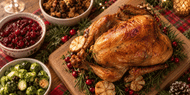
The Classic Side Dishes for a Traditional Christmas Turkey
Posted by Copas Farm Shop on 20th Oct 2026
The best side dishes for a Christmas turkey are roast potatoes, pigs in blankets, stuffing, braised red cabbage, roasted parsnips, honey-glazed carrots, sprouts with bacon and chestnuts, and a rich turkey gravy. Together, these classics balance the deep, savoury flavour of a well-reared bird with sweetness, crunch and warmth, the hallmarks of a traditional British Christmas table.
Key takeaways
- Roast potatoes cooked in goose fat or duck fat reach a deeper golden crust and a fluffier interior than those cooked in vegetable oil.
- A good turkey gravy starts with the giblets and resting juices, both of which come with a properly prepared bird from a farm with high-welfare rearing standards.
- Pigs in blankets should be given their own roasting tray rather than cooked beneath the turkey, so the bacon crisps rather than steams.
- Sprouts benefit from a high-heat finish with smoked bacon lardons and whole chestnuts, which tempers any bitterness and adds depth.
- Stuffing cooked outside the bird, in a separate dish rather than the cavity, develops a proper crust and reaches a safe internal temperature more reliably.
- The full spread of classic trimmings can be prepared in stages over two days, reducing the pressure on Christmas morning significantly.
What are the classic side dishes for a traditional British Christmas turkey?
A traditional British Christmas turkey dinner centres on the bird, but it's the surrounding dishes that make the meal feel complete. The canon of classic sides has remained remarkably consistent across generations: roast potatoes, pigs in blankets, sage and onion stuffing, roasted root vegetables (parsnips and carrots in particular), Brussels sprouts and a proper gravy.
Each dish has a defined role at the table. Roast potatoes provide crunch and substance. Stuffing adds herbaceous warmth and a softer texture that contrasts with the meat. The vegetables bring sweetness and colour. Pigs in blankets offer a hit of salt and smoke. Gravy ties everything together.
A well-sourced Christmas Turkey from a farm that slow-grows and dry-ages its birds will yield resting juices of genuine depth, and those juices are the foundation of a gravy that no stock cube can replicate. Starting with a quality bird is not just about the meat; it shapes every component on the plate.
How do you make the perfect roast potatoes for Christmas?
Perfect roast potatoes require three things: the right variety, the right fat and the right temperature. Maris Piper or King Edward potatoes hold their shape during parboiling and develop a rough, starchy surface that crisps in hot fat. Floury varieties are the ones to choose; waxy potatoes won't give you the shatter-and-fluff result you are looking for.
Follow these steps for consistently excellent roast potatoes:
- Peel and cut the potatoes into large, even chunks, roughly the size of a large egg.
- Parboil in well-salted water for 8 to 10 minutes until the edges begin to soften.
- Drain thoroughly and shake vigorously in the colander to roughen the surface.
- Dust lightly with plain flour or semolina, this creates an extra-crisp shell.
- Heat goose fat or duck fat in a roasting tin in a 220°C oven until it is smoking.
- Carefully add the potatoes, turning once to coat, then roast for 45 to 55 minutes, turning once halfway through.
- Season with sea salt flakes the moment they come out of the oven.
Goose fat produces a noticeably richer, more golden result than vegetable alternatives. If you have roasted a goose or are ordering one alongside your turkey, the fat it releases during cooking is liquid gold for this purpose.
What is the best way to cook stuffing for a Christmas roast?
Sage and onion stuffing is the traditional British accompaniment to Christmas turkey. Cooking it separately from the bird, in a buttered ovenproof dish rather than inside the cavity, has two practical advantages: the stuffing develops a proper golden crust on top, and the turkey itself cooks more evenly without a cold mass at its centre.
A well-made stuffing combines good-quality sausage meat, finely diced softened onion, fresh sage, thyme and breadcrumbs. Season it generously with salt, pepper and a little freshly grated nutmeg. Press it into the dish, dot the surface with butter, and bake at 180°C for around 35 to 40 minutes until deeply golden and cooked through.
Chestnut stuffing, with whole or roughly chopped roasted chestnuts folded through the mixture, adds a sweet, earthy note that works particularly well with the richer flavour of a slow-grown, free-range bird. It's a small adjustment that elevates the dish considerably.
How should you prepare Brussels sprouts to make them genuinely good?
Brussels sprouts have an unfair reputation, and it almost always traces back to overcooking. Waterlogged, grey sprouts are a result of boiling them for too long. Cooked correctly, they are nutty, slightly bitter in a pleasant way, and pair beautifully with rich meats.
The approach that works best for Christmas:
- Trim the base and remove any damaged outer leaves. Score a shallow cross in the base of each sprout to help heat penetrate evenly.
- Blanch in well-salted boiling water for 3 to 4 minutes only, they should still be bright green and have a little resistance when pierced.
- Drain and refresh under cold water immediately to stop the cooking.
- When ready to serve, heat a wide frying pan until very hot. Add smoked bacon lardons and cook until the fat begins to render and the bacon colours.
- Add the sprouts and cook on a high heat for 2 to 3 minutes, tossing regularly, until they pick up some colour at the edges.
- Add pre-cooked whole chestnuts (vacuum-packed ones work well) for the final minute and season to taste.
This method can be prepared in advance up to the blanching stage, making the final cook a matter of minutes on the day itself.
Which roasted vegetables belong on the classic Christmas table?
Parsnips and carrots are the two root vegetables that belong on a traditional Christmas turkey plate. Both respond well to high-heat roasting, both carry natural sweetness that complements the savoury depth of the bird, and both can share the oven with the roast potatoes.
Parsnips should be peeled, halved lengthways and parboiled briefly, about 5 minutes, before roasting in a hot oven with a drizzle of honey and a light dusting of plain flour. The result is a caramelised, slightly sticky exterior with a fluffy interior. They take approximately 35 to 40 minutes at 200°C.
Carrots work well roasted with thyme and a little butter, or honey-glazed in a pan. For a larger gathering, glazed carrots cooked on the hob, in butter, a splash of orange juice and a teaspoon of honey, are easier to manage and free up oven space for the potatoes and parsnips.
Both vegetables can be parboiled the day before and stored in the refrigerator, ready for the oven on Christmas Day.
Why do pigs in blankets matter so much to the Christmas spread?
Pigs in blankets, chipolata sausages wrapped in streaky bacon, are, for many, the non-negotiable element of a Christmas turkey dinner. They contribute salt, smokiness and an irresistible texture that no other dish on the table provides. Their popularity is partly explained by the contrast they offer: where the turkey is lean and mildly flavoured, the pigs in blankets are rich, fatty and intensely savoury.
The key to excellent pigs in blankets is a hot, dry roasting environment. Place them in a single layer in their own roasting tin, not nestled around the turkey where they will steam rather than crisp. Roast at 200°C for 20 to 25 minutes, turning once, until the bacon is deeply caramelised and the sausages are cooked through.
Our existing guide to pigs in blankets covers quantities per person and timing in detail; if you're planning a large table, it's worth reading in advance. As a general rule, allow at least three per person, and more if your guests are enthusiastic.
How do you make a proper turkey gravy from scratch?
Importantly, a properly made gravy is the element that separates a memorable Christmas dinner from a merely adequate one. The foundation is the resting juices from the turkey combined with a stock made from the giblets.
Follow this method:
- The day before, simmer the turkey giblets (neck, heart, not the liver) with a roughly chopped carrot, onion and celery stick, a bay leaf and a peppercorn or two in 750ml of cold water. Simmer for 1 to 1½ hours, then strain and refrigerate.
- Once the turkey comes out of the roasting tin to rest, pour off most of the fat, leaving around 2 tablespoons in the tin.
- Set the tin on the hob over a medium heat. Stir in 2 tablespoons of plain flour and cook for 2 minutes, scraping up any caramelised residue from the base of the tin.
- Add a splash of dry white wine or port and let it bubble for a minute.
- Gradually pour in the giblet stock, stirring constantly. Bring to a steady simmer and cook for 8 to 10 minutes until glossy and well-reduced.
- Season, strain if necessary, and keep warm.
In our experience at Copas, a well-reared bird, slow-grown and rested properly before carving, will yield far more flavour in its resting juices than a factory-reared turkey. This is where provenance earns its place on the plate.
Classic Christmas side dishes: a planning comparison
| Side dish | Prep ahead? | Oven or hob? | Notes |
|---|---|---|---|
| Roast potatoes | Parboil day before | Oven, 220°C | Needs smoking-hot fat |
| Sage and onion stuffing | Assemble day before | Oven, 180°C | Cook separately for even results |
| Pigs in blankets | Wrap day before | Oven, 200°C | Separate tray, never beneath the turkey |
| Roasted parsnips | Parboil day before | Oven, 200°C | Honey-glaze just before roasting |
| Glazed carrots | Prep day before | Hob | Frees oven space on Christmas Day |
| Brussels sprouts with bacon | Blanch day before | Hob, high heat | Finish at the last minute |
| Turkey gravy | Giblet stock day before | Hob | Finish in the resting tin on the day |
Frequently Asked Questions
What are the essential side dishes for a Christmas turkey dinner? The essential sides for a traditional British Christmas free-range turkey are roast potatoes, pigs in blankets, sage and onion stuffing, roasted parsnips, carrots, Brussels sprouts with bacon and chestnuts, and turkey gravy. Each dish has a clear role, crunch, salt, sweetness and depth, and the combination is what defines a traditional festive meal rather than any single element alone.
Can Christmas side dishes be prepared in advance? Most of the classic sides can be partially prepared one to two days ahead. Potatoes and parsnips can be parboiled and refrigerated. Stuffing can be assembled and refrigerated uncooked. Sprouts can be blanched and refreshed. Giblet stock for the gravy can be made the day before. Doing this spreads the workload across two days and leaves Christmas morning for the bird itself.
What fat is best for roast potatoes at Christmas? Goose fat produces the crispiest, most flavourful roast potatoes. Duck fat is a close second. Both have high smoke points and a richness that vegetable or sunflower oil cannot match. If you are roasting a goose alongside or instead of your turkey, the fat it renders during cooking is ideal for this purpose.
How many pigs in blankets should you allow per person? A minimum of three pigs in blankets per person is a reasonable starting point for a Christmas dinner. For guests who are particularly fond of them, which is most guests, four or five is a safer estimate. They can be prepared in large batches and cooked in multiple trays simultaneously, so scaling up is straightforward.
What is the difference between cooking stuffing inside the turkey versus separately? Stuffing cooked inside the cavity absorbs more of the turkey's cooking juices, which adds flavour, but it also slows the bird's cooking time and can make it harder to achieve a safe internal temperature throughout. Stuffing cooked separately in a dish reaches a safe temperature more reliably, develops a golden crust on top, and allows the turkey to cook evenly. The practical advantages of cooking it separately outweigh the small loss of flavour.
What vegetables go well with Christmas turkey besides sprouts and parsnips? Honey-glazed carrots are the most common third vegetable at a traditional Christmas dinner. Braised red cabbage, cooked slowly with apple, red wine and a little vinegar, is an excellent addition, particularly if the meal includes goose or duck alongside your turkey. Leeks in a light cream sauce work well for a larger gathering where variety on the table matters.
Should the gravy be made from the turkey juices or a stock cube? Gravy made from turkey resting juices and a homemade giblet stock is substantially better than one made with a stock cube. The resting juices from a properly reared, free-range bird carry deep, concentrated flavour that a stock cube simply cannot replicate. Making the giblet stock the day before reduces the pressure on Christmas Day and means the gravy is ready in ten minutes once the bird comes out of the oven.
If you’d rather spend less time in the kitchen and more time with the family, take a look at our range of sides and trimmings, all ready to go alongside your Copas turkey.