
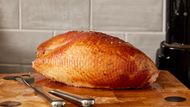
Turkey Cooking Times for Crowns and Whole Birds
Posted by Copas Farm Shop on 13th Oct 2026
A whole turkey at 180°C (160°C fan / Gas 4) needs roughly 20 minutes per kg, plus 90 minutes. A turkey crown needs around 20 minutes per kg, plus 70 minutes. A boneless, rolled turkey joint needs 20 minutes per kg, plus 60 minutes. All cuts should reach an internal temperature of 75°C at the thickest part of the thigh or joint before you rest them.
Key takeaways
- Whole turkey: 20 minutes per kg plus 90 minutes at 180°C (160°C fan / Gas 4), rested for at least 30 minutes before carving.
- Turkey crown: 20 minutes per kg plus 70 minutes at the same temperature, rested for 20–30 minutes.
- Boneless, rolled turkey joint: 20 minutes per kg plus 60 minutes, rested for 20 minutes.
- Turkey legs (slow-cooked): 3–3.5 hours at 160°C (140°C fan) covered, then 20 minutes uncovered to crisp the skin.
- The only reliable doneness check is a meat thermometer reading 75°C at the thickest point, juices running clear is a useful secondary signal, not a replacement.
- A well-raised, slow-grown bird from a farm like Copas Farm Shop benefits from a longer rest — 30–45 minutes, because the denser muscle holds heat and the rested meat carves more cleanly.
What are the correct turkey cooking times for each cut?
The table below gives you a reliable starting framework for a bird cooked at 180°C (160°C fan / Gas 4). Always verify with a thermometer, oven temperatures vary, and the shape of the bird matters as much as the weight.
| Cut | Base formula | Example: 4 kg | Example: 6 kg | Rest time |
|---|---|---|---|---|
| Whole turkey | 20 min/kg + 90 min | 170 min (2 hrs 50 min) | 210 min (3 hrs 30 min) | 30–45 min |
| Turkey crown | 20 min/kg + 70 min | 150 min (2 hrs 30 min) | 190 min (3 hrs 10 min) | 20–30 min |
| Boneless rolled joint | 20 min/kg + 60 min | 140 min (2 hrs 20 min) | 180 min (3 hrs) | 20 min |
| Turkey legs (slow) | 3–3.5 hrs at 160°C | — | — | 10–15 min |
These timings assume the bird has come fully to room temperature before going into the oven — which makes a real difference to how evenly it cooks.
How do you cook a whole turkey without drying it out?
Start by taking the bird out of the fridge at least two hours before cooking. A cold bird going into a hot oven cooks unevenly: the breast dries out while the legs catch up. Bringing it to room temperature first closes that gap.
Cover the breast loosely with foil for the first two-thirds of cooking, then remove it for the final 45–60 minutes so the skin colours and crisps. Basting every 45 minutes with the pan juices keeps the surface moist and adds flavour to the drippings for your gravy.
Season generously under and over the skin; butter mixed with herbs pushed under the breast skin keeps the meat basted from the inside. Insert the thermometer into the thickest part of the thigh, away from the bone. When it reads 75°C, the bird is done.
The rest is not optional. Carry-over cooking takes the internal temperature up another 3–5°C after you pull the turkey from the oven, and resting for 30–45 minutes lets the muscle fibres relax so the juices redistribute rather than running off the board when you carve.
How long do you cook a turkey crown?
A turkey crown, the breast still on the bone, legs removed, is the most popular choice for smaller gatherings and for anyone who wants simpler carving. Because it's a more compact shape, it cooks faster than a whole bird of equivalent breast weight.
At 180°C (160°C fan / Gas 4), allow 20 minutes per kg plus 70 minutes. A 2 kg crown takes about 110 minutes; a 3 kg crown takes about 130 minutes. Always verify with a thermometer reading 75°C at the thickest point of the breast.
Crowns dry out more readily than whole birds because there is no surrounding leg meat to act as a buffer. Keep the crown covered with foil or a butter-soaked cloth (called a bard) for most of the cooking time, removing it for the last 20–30 minutes to brown the skin. Resting for 20–30 minutes is just as important here as with a whole bird.
How long do you cook a boned and rolled turkey?
A boneless, rolled turkey joint cooks faster and more predictably than any other cut, because the uniform shape means heat reaches the centre evenly. There is no bone to slow conduction at the thickest point.
At 180°C (160°C fan / Gas 4), allow 20 minutes per kg plus 60 minutes. A 2 kg rolled joint takes around 100 minutes; a 3 kg joint takes around 120 minutes. Check the centre with a thermometer; it must read 75°C, and because the whole joint is muscle rather than bone, there is nowhere to hide an undercooked spot.
Rolled joints often benefit from being sealed in a hot pan or under a very high oven temperature (220°C) for 15 minutes at the start, to develop colour on the outside before you drop the temperature for the remainder of the cooking time. Rest for at least 20 minutes before slicing.
How do you slow cook turkey legs in the oven?
Turkey legs respond well to low, slow cooking, which breaks down the tougher connective tissue in the dark meat and leaves the flesh tender rather than chewy. High-heat roasting alone tends to tighten the leg muscles before they soften, producing a dry result.
Set the oven to 160°C (140°C fan / Gas 3). Place the legs in a deep roasting tin, add enough stock or wine to come halfway up the sides, and cover tightly with foil or a lid. Cook for 3 to 3.5 hours until the meat is falling towards the bone and a thermometer reads 75°C. Remove the foil, raise the oven to 200°C (180°C fan), and roast for a further 20 minutes to crisp the skin.
This method works particularly well with free-range turkeys that have been slow-grown on pasture, because the active leg muscles have more flavour to give — and more collagen to melt into the braising liquid, which makes an outstanding base for gravy.
Does turkey breed or farming method affect cooking time?
Broadly, no — the weight-based formula holds regardless of breed. What changes is the cooking experience: a slow-grown, free-range bird tends to have denser muscle and a slightly lower water content than an intensively reared bird, which means it retains moisture better and the skin crisps more reliably.
Importantly, at Copas all turkeys are slow-grown on open pasture, hand-plucked and dry-aged, a process that removes surface moisture and concentrates flavour. The practical consequence at the stove is that a dry-aged bird produces less steaming in the oven, browning rather than sweating, so you may find the skin colours a little faster. Keep an eye on it after you remove the foil and adjust the temperature down by 10°C if it's colouring too quickly.
The rest period is equally worth respecting for a quality bird. Thirty to forty-five minutes under a loose foil tent is not wasted time, it is the stage where flavour and texture are finished.
What temperature should turkey be cooked to in the UK?
In the UK, the Food Standards Agency recommends that poultry reaches a core temperature of 75°C, and that this temperature is sustained for at least two minutes. A meat thermometer is the only reliable way to verify this.
Insert the probe into the thickest part of the thigh (on a whole bird), avoiding contact with bone. On a crown or rolled joint, probe the deepest point of the breast or the geometric centre of the roll. If the temperature is below 75°C, return the bird to the oven and check every 10–15 minutes again.
Juices running clear when you pierce the thigh is a useful secondary check; pink juices indicate undercooking, but clear juices alone are not conclusive. A thermometer is definitive; the visual check is a supplement.
How much difference does resting make?
Resting is where a well-cooked turkey becomes a properly cooked turkey. During roasting, heat drives moisture towards the centre of the meat. If you carve immediately, that liquid runs straight off the board. Rest the bird, and those juices redistribute through the muscle, keeping every slice moist rather than dry at the edges.
For a whole turkey, 30–45 minutes is the minimum. The bird will still be hot after 45 minutes; it holds heat well, especially under a loose foil tent. A turkey crown needs 20–30 minutes. A rolled joint needs at least 20 minutes.
Use the resting time to finish your roast potatoes, warm your plates and make the gravy from the pan drippings. The timing works out almost perfectly if you plan it that way.
Whole turkey vs turkey crown: which should you choose?
The right choice depends on your guest count and how confident you feel about carving. This is covered in more detail in our guides to turkey sizing, so here is the short version for cooking purposes.
| Factor | Whole turkey | Turkey crown | Boneless rolled joint |
|---|---|---|---|
| Cooking time | Longest | Moderate | Shortest and most predictable |
| Carving difficulty | Requires some skill | Moderate | Very easy |
| Flavour depth | Highest — legs add richness | Good | Good, though less complex |
| Best for | Larger tables; confident carvers | 4–8 guests; simpler service | Small tables; stress-free serving |
| Leftovers | Abundant | Moderate | Limited |
If you want depth of flavour and the drama of a full bird at the table, a whole turkey wins. If you want a more forgiving cook with simpler carving, a crown is the practical choice. A boneless rolled joint is the most straightforward of all; it carves like a joint of beef and suits a smaller table well.
You can browse the full range of Copas turkeys to find the cut and size that fits your table.
Frequently Asked Questions
How long does a 5 kg turkey take to cook? At 180°C (160°C fan / Gas 4), a 5 kg whole turkey needs approximately 190 minutes (3 hours 10 minutes) — that is 20 minutes per kg (100 minutes) plus 90 minutes. Always confirm with a thermometer reading 75°C in the thickest part of the thigh, and rest for at least 30 minutes before carving.
Do I need to cover a turkey with foil while cooking? Covering the breast with foil for the first two-thirds of cooking protects the white meat from drying out while the darker leg meat catches up. Remove the foil for the final 45–60 minutes so the skin can brown and crisp. A turkey crown benefits from the same approach, with the foil removed for the last 20–30 minutes.
Should I start cooking turkey at a high temperature? Some cooks start with 220°C for 20–30 minutes to develop colour before reducing to 180°C for the remainder. This can help with a paler-skinned bird, but a dry-aged bird from a farm producer will often colour well without the initial blast. Either approach works — what matters is finishing at 75°C internal temperature, not the route taken to get there.
Can you cook a turkey crown from frozen? No. A turkey crown — or any cut of turkey — must be fully defrosted before cooking. Cooking from frozen means the centre remains undercooked long after the outside appears done, which is both a food safety risk and a culinary one. A large crown can take 24–48 hours to defrost in the fridge; plan accordingly.
How do I know when a turkey crown is done? Insert a meat thermometer into the thickest point of the breast, ensuring the probe is not touching the bone. A reading of 75°C means it's done. The juices at that point should also run clear, not pink. Rest the crown for 20–30 minutes before carving.
How long should I rest a turkey before carving? A whole turkey needs a minimum of 30 minutes and can rest for up to 45 minutes under a loose foil tent without losing meaningful heat. A crown or rolled joint needs 20–30 minutes. The rest allows the internal juices to redistribute, making every slice more moist and easier to carve cleanly.
What is the difference between cooking a bone-in and boneless turkey joint? A boneless rolled joint cooks more quickly and evenly than a bone-in cut of the same weight, because there is no bone slowing heat transfer at the centre. It also carves more easily. The trade-off is a slight reduction in flavour depth, bone and dark meat both contribute to the complexity of a whole bird or crown. Allow 20 minutes per kg plus 60 minutes for a boneless joint, versus 20 minutes per kg plus 70 minutes for a crown.