
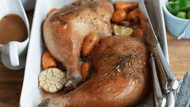
Turkey Legs: All There Is To Know
Posted by Copas Farm Shop on 23rd Sep 2026
Turkey legs are available to buy online from farm shops and premium butchers, including Copas Farm Shop, where they're sold as part of whole free-range birds or as individual cuts. Slow-grown and full of flavour, they're one of the most rewarding cuts on the bird, affordable, forgiving to cook, and genuinely satisfying at the table.
Key takeaways
- Turkey legs (drumstick and thigh) are dark meat cuts with more fat marbling than the breast, which means they stay moist through long, slow cooking without constant attention.
- Free-range turkey legs from a farm such as Copas Farm Shop benefit from the bird's natural movement; muscle built through genuine outdoor ranging develops deeper, richer flavour than intensively reared alternatives.
- Turkey legs are well-suited to braising, slow-roasting and smoking, methods that suit a relaxed, unhurried cook.
- Unlike a whole bird, individual turkey legs are manageable for smaller households: one leg comfortably feeds two to three people.
- Turkey legs are available year-round, not just at Christmas, making them a practical choice for any season.
Where can you buy turkey legs in the UK?
Turkey legs are sold by farm shops, premium online butchers, and a small number of specialist poultry suppliers. Copas free-range turkeys — raised on the family farm since 1957, are available to order online, with cuts and whole birds delivered directly to your door. The advantage of buying from a farm shop over a supermarket is traceability: you know the breed, the farming method, and how the bird was raised, rather than receiving an unspecified commodity cut.
If you're buying turkey legs specifically, look for suppliers who can confirm the bird was free-range and slow-grown. Leg meat from a bird that has genuinely ranged outdoors will be darker, firmer, and more flavourful, the muscle has been used, which is exactly what you want.
Why do turkey legs taste better than turkey breast?
Turkey legs are dark meat. That distinction matters because dark meat contains a higher proportion of myoglobin, the protein that delivers oxygen to working muscles, as well as more intramuscular fat. Both of these things translate directly to flavour and moisture in the finished dish.
Importantly, breast meat is leaner and more forgiving to slice, but it dries out quickly if slightly overcooked. A turkey leg is almost the opposite: it benefits from more time in the oven, not less. The fat bastes the meat from within, the connective tissue breaks down slowly into gelatine, and what you're left with is something rich, tender and deeply savoury.
Are turkey legs only for Christmas?
Not remotely. One of the most convincing reasons to order turkey legs outside the festive season is precisely that no one expects them, which means you're not competing with a calendar's worth of tradition for a cut that works just as well on a wet Tuesday in February as it does in December.
Turkey legs braise beautifully with wine and root vegetables, roast well with herbs and butter, and hold up to longer cooking on a low heat that you can largely leave alone. For anyone who wants a farm-raised centrepiece that doesn't require the planning of a whole bird, a pair of turkey legs is one of the most practical answers.
Turkey legs vs. a whole turkey: which should you order?
The honest answer depends on your table size and your confidence in the kitchen. Here's how they compare:
| Option | Best for | Feeds | Key consideration |
|---|---|---|---|
| Whole turkey | Large gatherings, centrepiece occasions | 8–14 people | Requires more prep, resting time, carving |
| Turkey crown | Medium tables, no dark meat preference | 4–8 people | Less flavour complexity; breast only |
| Turkey legs (pair) | Smaller households, casual meals | 2–4 people | Full flavour, simple to cook and serve |
| Single turkey leg | Weeknight cook, one or two people | 1–2 people | Best braised or slow-roasted |
Turkey legs win on simplicity. There's no carving to worry about; each leg is already a self-contained portion, and the bone acts as a natural handle if you're eating more informally.
What's the best way to cook turkey legs?
Turkey legs suit low, slow heat above almost anything else. Braising, placing them in a covered pot with stock, aromatics and a splash of wine at around 160°C for two to two and a half hours, produces consistently good results. The meat pulls cleanly from the bone, and the cooking liquid reduces into a ready-made sauce.
In practice, the most common mistake is rushing the finish. For a crispier result, remove the lid or transfer to a higher heat (around 200°C) for the final twenty minutes. If you're slow-roasting, season generously with salt and fat, and don't rush the resting period; fifteen minutes uncovered before serving makes a real difference to how the meat holds together when you carve or pull it.
Frequently Asked Questions
Can I order turkey legs online in the UK? Yes. Premium farm shops including Copas Farm Shop offer turkey products online, with home delivery across the UK. It's worth ordering in advance during peak season — free-range birds are produced in limited numbers and sell out most years.
How many turkey legs do I need per person? One turkey leg feeds two people comfortably, particularly when served with generous sides. For a more informal spread where the legs are pulled rather than carved, one leg between two is a reliable guide.
Do turkey legs need to be marinated before cooking? Marinating isn't essential, but it does add another layer of flavour. A simple overnight brine, cold water, salt, a little sugar, bay and peppercorns — draws moisture into the meat and seasons it all the way through. If you're short on time, a dry rub applied an hour before cooking achieves much the same character without the wait.
Are free-range turkey legs worth the extra cost? The flavour difference between a free-range, slow-grown bird and an intensively reared one is more pronounced in the legs than anywhere else on the bird. The muscle built through genuine outdoor ranging has real depth, the kind that holds up to braising and slow-roasting rather than disappearing into the background.
Can turkey legs be frozen? Yes, turkey legs freeze well. If buying fresh, freeze on the day of delivery in airtight packaging and defrost slowly in the fridge over twenty-four hours before cooking. Don't rush the defrost, an even thaw matters more with larger cuts.