
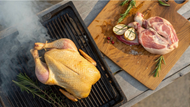
Whole Chicken or Spatchcock on the BBQ: Which Gets Better Results?
Posted by Copas Farm Shop on 16th Sep 2026
Spatchcock wins on the BBQ. Removing the backbone and flattening the bird gives you even heat distribution, a shorter cook time, and crispier skin across the whole surface. A whole chicken on the BBQ risks an overcooked exterior and underdone joints. For most home cooks, spatchcock is the more reliable, more flavourful choice.
Key takeaways
- Spatchcocking reduces BBQ cook time significantly — a flattened bird sits closer to the heat and cooks more evenly than a round, dense whole chicken.
- A whole chicken on the BBQ benefits from indirect heat and a lid-on setup, but it still requires careful monitoring to avoid dry breast meat and raw thigh joints cooking at different rates.
- Free-range chicken repays both methods — the slower-grown muscle holds its structure better under direct heat and delivers noticeably more flavour than an intensively reared bird.
- Spatchcock is better suited to charcoal and gas BBQs alike; a whole chicken on the BBQ is really a job for a kettle-style grill with a proper lid and a meat thermometer.
- The internal temperature that matters is 75°C at the thickest part of the thigh — the method you choose affects how reliably you hit it.
Why does cooking method matter so much on a BBQ?
A BBQ is not an oven. Heat is fierce, directional, and uneven — which is exactly what makes it brilliant for flavour and unforgiving for a dense whole bird. The problem with a whole chicken on the BBQ is geometry: the breast sits proud and takes the direct heat first, while the thigh joints — the thickest and last part to cook — lag behind. By the time the thighs are safe to eat, the breast can be dry.
Spatchcocking solves this mechanically. Once the backbone is removed and the bird is pressed flat, every part of the chicken is roughly the same distance from the grill grate. The skin stretches across a wide, flat surface and crisps evenly. The joints are exposed rather than tucked inward, so they cook at the same rate as the breast.
What is spatchcock, exactly?
Spatchcock — also called butterflied chicken — means removing the backbone with kitchen scissors or a sharp knife, then pressing the bird flat. The result is a chicken half the height of a whole bird, twice the surface area, and far more manageable on a grill. The technique takes about three minutes with a pair of decent kitchen scissors and no specialist skill.
Whole chicken vs spatchcock on the BBQ: a direct comparison
| Whole chicken | Spatchcock | |
|---|---|---|
| Best for | Slow, indirect BBQ cooking with a lid | Direct and indirect heat, quicker cook |
| Cook time | 1.5–2 hours (indirect heat) | 45–60 minutes |
| Even cooking | Difficult — breast overcooks before thigh is done | Much easier — flat surface cooks uniformly |
| Skin crispness | Partial — underside stays soft | Excellent — full surface exposed to heat |
| Kit required | Kettle grill with lid and thermometer | Any BBQ with a lid |
| Skill level | Moderate | Beginner-friendly |
Can you cook a whole chicken on the BBQ successfully?
Yes — but you need the right setup. A whole chicken on the BBQ works best with a two-zone fire: hot coals banked to one side, the chicken sitting over the cool side with the lid on. This turns your BBQ into a makeshift oven. Cook the bird through on indirect heat first, then move it briefly over the direct heat to crisp the skin at the end.
The non-negotiable here is a meat thermometer. Pull the chicken when the thigh registers 75°C and rest it for ten minutes before carving. Without a thermometer, you're guessing — and with a whole bird, guessing tends to mean either underdone joints or sawdust breast meat.
Which method suits your BBQ setup?
Choose spatchcock if: you have a standard kettle grill or gas BBQ, you want to feed people within the hour, or you're cooking for more than four people and want consistent results without babysitting the fire.
Choose whole chicken if: you have a larger kettle grill with good temperature control, you enjoy the process of a long, slow cook, or you want to stuff the cavity with aromatics — lemon, garlic, fresh thyme — which you can't do with a flattened bird.
In practice, both methods benefit enormously from starting with the right bird. A free-range chicken from Copas Farm Shop, slow-grown on open pasture, has the muscle density and fat distribution to hold up to BBQ heat and deliver genuine depth of flavour. A fast-reared bird tends to dry out on both methods.
Frequently Asked Questions
Does spatchcock chicken need a marinade on the BBQ? A marinade or dry rub is worth doing but not essential. Because the bird is flat, a marinade penetrates more evenly and in less time — two hours in the fridge is usually enough. At minimum, oil the skin well and season generously with salt before it goes on the grill.
Is free-range chicken better than organic chicken for BBQ? The honest answer is that the farming method matters more than the label. Free-range chickens raised on pasture with space to roam develop firmer, more flavourful meat than intensively reared birds.
How do you stop BBQ chicken from burning on the outside before it's cooked through? Use indirect heat for most of the cook. Move the chicken to the cooler side of the grill and close the lid to trap heat. Only move it directly over the coals or burners for the final few minutes to crisp the skin. A thermometer is the safest way to know when the inside is ready without relying on colour or timing alone.
Can you spatchcock a whole chicken the night before? Yes — and it's worth doing. Preparing the bird the night before lets you dry-brine it (salt it uncovered in the fridge), which draws out surface moisture and leads to significantly crispier skin on the BBQ. It also means less faff on the day.