
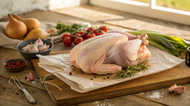
Your complete guide to buying and cooking turkey from farm to table
Posted by Copas Farm Shop on 22nd Jul 2026
Buying and cooking a turkey well comes down to three decisions: choosing a bird raised slowly on open pasture, ordering it early enough to secure the right size, and resting it properly after it comes out of the oven. Get those three things right and everything else follows. Copas has been raising free-range turkeys on the family farm in Berkshire since 1957 — what follows is the full picture, from understanding what to look for when buying to carving and serving.
Key takeaways
- A slow-grown, free-range turkey will have spent at least 24 weeks on pasture — roughly twice the lifespan of a commercial bird — which directly affects flavour and texture.
- Allow 500g of dressed turkey weight per person; a 5kg bird feeds 8–10 guests comfortably.
- Dry-aged turkey should be kept chilled on arrival, brought to room temperature for 1–2 hours before cooking, and rested for a minimum of 30 minutes after.
- Copas turkeys typically sell out by early December each year — ordering in October or November is the safer window.
- Oven temperature for a whole turkey: 190°C (fan 170°C) for the first 30 minutes, then 170°C (fan 150°C) for the remaining time.
- A fully cooked turkey registers 75°C at the thickest part of the thigh when tested with a meat thermometer.
What makes a free-range, slow-grown turkey different from a supermarket bird?
A free-range, slow-grown turkey is raised on open pasture for a minimum of 24 weeks, compared with 12–14 weeks for a standard commercial bird. That extra time on grass allows the muscles to develop properly, producing a firmer texture and a deeper, fuller flavour in the meat.
Commercial turkeys are often bred for breast size alone, which can result in a bird that's disproportionate and difficult to cook evenly. A slower-grown bird carries more natural fat through the meat and under the skin, which bastes the breast from within during roasting.
Dry-ageing after slaughter removes residual moisture and concentrates the flavour further. At Copas, birds are hand-plucked and dry-aged before dispatch — a process that makes a measurable difference to the finished roast compared with wet-processed alternatives.
How do you choose the right size turkey for your table?
The standard guide is 500g of dressed (oven-ready) weight per person. A 5kg bird suits 8–10 guests; a 6–7kg bird covers 12 comfortably. If you want leftovers — and most households do — add an extra 1–1.5kg to whichever weight you calculate.
Dressed weight refers to the bird after plucking, drawing and preparation. Some listings quote live weight, which runs approximately 20–25% higher than dressed weight. Always confirm which weight is being quoted before ordering.
If your household is smaller, a crown — the breast joint with the rib cage removed — is worth considering. A 2.5–3kg crown serves 6–8 people and cooks more quickly than a whole bird, reducing the risk of overcooked breast meat.
What welfare and production standards should you look for when buying turkey in the UK?
The minimum meaningful markers to look for when buying UK turkey are: free-range certification, outdoor access throughout the bird's life, and a confirmed slow-growth breed. These three criteria together indicate the bird has not been intensively produced.
RSPCA Assured certification requires that birds have continuous daytime access to outdoor range and that stocking densities indoors meet defined limits. Red Tractor covers basic food safety standards but does not guarantee outdoor access or slow growth — the two are not equivalent.
Heritage breeds such as the Norfolk Black and Bronze turkey grow more slowly and forage more actively than commercial white breeds. In Copas's experience across nearly seven decades of farming, these breeds consistently produce birds with the depth of flavour and texture that justify the higher price.
When should you order your turkey, and how far in advance?
Order by early November at the latest if you want guaranteed choice of size and breed. The best free-range farms sell out most years, often before mid-December. Waiting until the first week of December is possible but carries real risk of missing your preferred size.
Most premium turkey farms dispatch in the week before Christmas, typically 20–23 December for a 25 December table. Farms will usually confirm your delivery window at the time of ordering so you can plan chilling and preparation accordingly.
If you're buying for a smaller occasion outside the Christmas window — Easter or a family Sunday roast, for example — check availability directly with the farm. Supply outside December is more limited, and lead times can be longer.
How should you store a fresh turkey when it arrives?
Remove the turkey from its outer packaging immediately on arrival and place it on a rack over a tray in the coldest part of your refrigerator (1–4°C). Keeping air circulating around the bird prevents moisture build-up and maintains the benefits of dry-ageing.
A fresh turkey will keep safely in the refrigerator for 3–5 days from the date of dispatch, provided temperatures remain consistent. Don't store it in a sealed bag or wrap it tightly in cling film — this traps moisture and works against the dry-aged surface.
If your refrigerator is too small, a cold garage (below 4°C) with the bird covered loosely in muslin or a clean tea towel is a practical alternative in December. A thermometer in the space is worth using to be sure.
How do you prepare a whole turkey for roasting?
Follow these steps in order for a reliable result:
- Remove from the refrigerator 1–2 hours before cooking. A cold bird placed directly into a hot oven cooks unevenly — the outside dries before the inside reaches temperature.
- Pat the skin dry with kitchen paper. Dry skin crisps properly; any surface moisture will steam rather than roast.
- Season generously inside and out. Fine sea salt and freshly ground black pepper are sufficient. Rub butter or a light coating of oil under the breast skin if you want additional basting.
- Truss the legs loosely if using stuffing. This slows the cooking of the leg cavity slightly and helps the bird cook more evenly.
- Place breast-side up on a rack in a roasting tin. The rack keeps the bird above the pan juices and allows heat to circulate under the carcass.
- Add aromatics to the tin if desired. Halved onions, a head of garlic, fresh thyme and bay leaves under the rack contribute to the pan juices for gravy without affecting the bird's flavour directly.
How long does a turkey take to cook, and at what temperature?
Cooking time depends on the dressed weight of the bird. As a reliable baseline: start at 190°C (fan 170°C) for the first 30 minutes to set the skin, then reduce to 170°C (fan 150°C) for the remainder of the cooking time.
| Bird weight | Estimated cooking time | Serves (approx.) |
|---|---|---|
| 4–5kg | 2 hrs 30 min – 3 hrs | 8–10 |
| 5–6kg | 3 hrs – 3 hrs 30 min | 10–12 |
| 6–7kg | 3 hrs 30 min – 4 hrs | 12–14 |
| 7–8kg | 4 hrs – 4 hrs 30 min | 14–16 |
These times assume a bird at room temperature, unstuffed. If you're cooking with stuffing inside the cavity, add 30–45 minutes to the total time and always verify the core temperature at the stuffing's centre as well as the thigh.
The only reliable way to confirm a turkey is cooked is a meat thermometer. Insert it into the thickest part of the thigh, away from bone. The reading should reach 75°C before the bird comes out of the oven.
Whole turkey vs. turkey crown vs. turkey crown joint: which should you choose?
| Option | Best for | Limitation |
|---|---|---|
| Whole turkey | Tables of 10+, traditional presentation, leftover use | Requires large oven, longer resting time |
| Turkey crown (bone-in) | 6–10 guests, easier carving, reduced cook time | Less pan dripping for gravy; legs not included |
| Boneless turkey crown | 4–8 guests, simplest carving, compact storage | Least surface area for skin crispness |
| Turkey legs (separate) | Smaller households, slower-cook preparation | Not suited to a traditional centrepiece presentation |
A whole bird gives you the carcass for stock, the legs for longer cooking or braising, and the full range of textures across the table. A crown suits households with a standard-sized oven or a smaller guest list. The choice is practical as much as it is preferential.
How do you rest and carve a turkey properly?
Rest the turkey for a minimum of 30 minutes after it comes out of the oven, loosely tented with foil. A larger bird (7kg+) benefits from 45–60 minutes of resting time. Resting allows the muscle fibres to relax and the juices to redistribute — cutting into the bird immediately after cooking loses a significant amount of moisture onto the board.
To carve efficiently: remove the legs first by cutting through the skin at the joint and pressing the leg outward until the hip joint separates. Slice the thigh meat from the bone and keep it warm. Then carve the breast in long, downward slices parallel to the breastbone, working from the top of the breast toward the wing.
Use a sharp carving knife and a long-pronged carving fork. A blunt knife tears the meat and makes even slices impossible.
What are the most common mistakes people make when cooking turkey?
Not bringing the bird to room temperature. A turkey taken directly from the refrigerator into a 190°C oven cooks unevenly — the breast overcooks before the thigh reaches temperature.
Skipping the meat thermometer. Visual checks and the clear-juices test are unreliable indicators of internal temperature. A probe thermometer costs under £15 and removes all guesswork.
Basting too frequently. Opening the oven door every 20 minutes drops the oven temperature and extends cooking time. One baste at the midpoint is sufficient if the skin has been properly dried and oiled before cooking.
Carving too soon. This is the single most common cause of dry turkey. Even a 20-minute rest is better than none — 30 minutes is the practical minimum for a whole bird.
How do you use leftover turkey?
Turkey stock is the most practical first use: break the carcass into sections, cover with cold water, add a halved onion, a few peppercorns, a bay leaf and a stick of celery, and simmer for 2–3 hours. Strain and refrigerate. The stock keeps for 4 days chilled or 3 months frozen.
Leftover turkey meat holds well for 3–4 days in the refrigerator in a sealed container. Sliced cold breast suits sandwiches well; thigh and leg meat, which is more fibrous, suits longer cooking in pies, soups or a slow-cooked hash.
Cooked turkey should not be reheated more than once. Reheat to 75°C throughout and serve immediately.
Frequently Asked Questions
How much turkey do I need per person? Allow 500g of dressed (oven-ready) weight per person as a working guide. For 10 guests, a 5kg bird is the minimum; a 6kg bird gives you leftovers. If your table includes young children or lighter eaters, you can reduce slightly — but opting for larger is rarely a problem given how well turkey keeps in the refrigerator.
What is the difference between a fresh and a frozen turkey? A fresh turkey has never been frozen below 0°C and retains its natural texture and moisture content. A frozen bird undergoes cellular changes during freezing that can release more liquid during cooking. For a high-welfare, slow-grown bird, buying fresh and ordering from a farm with a confirmed dispatch date is the better choice.
Can I order a free-range turkey outside of Christmas? Yes, though supply is significantly more limited outside the November–December window. Some farms, including Copas, offer birds at Easter and for special orders at other times of year. Contact the farm directly to check availability rather than assuming the online shop reflects year-round stock.
What does dry-aged mean for turkey, and does it make a difference? Dry-ageing removes surface moisture from the bird after plucking, which concentrates flavour and produces crispier skin during roasting. A wet-processed bird — one that has been chilled in water — retains more moisture, which steams rather than roasts in the oven. The difference in skin texture and depth of flavour is noticeable.
How do I know when my turkey is fully cooked? The only reliable method is a meat thermometer inserted into the thickest part of the thigh, away from bone. The reading must reach 75°C. Juices that run clear at the thigh joint are a secondary indicator, but not a substitute for a temperature check.
Is it worth spending more on a premium free-range turkey? A slow-grown, free-range bird costs more because it takes longer to raise, occupies more land, and is processed by hand. The practical difference at the table is a firmer texture, fuller flavour, and better skin. Whether that justifies the price difference depends on the occasion — for a Christmas centrepiece that a household will plan a meal around, most people who have cooked both conclude it is worthwhile.
How early should I order my Christmas turkey? Order by early November for guaranteed size and breed availability. Free range turkeys from premium farms sell out most years — often before December begins. Leaving it until the second or third week of December significantly narrows your options.
Can I buy turkey from the same farm as other meats for a full festive order? Yes. Farms that raise turkey to a high welfare standard often produce other meats to the same specification. Consolidating your order from one trusted source means consistent provenance across the table and typically one delivery rather than several.